A couple of years ago I did an interview in Practical Literacy magazine with a very savvy (and appropriately named) teacher named Robyn English. For the last question of the interview, Robyn asked me this:
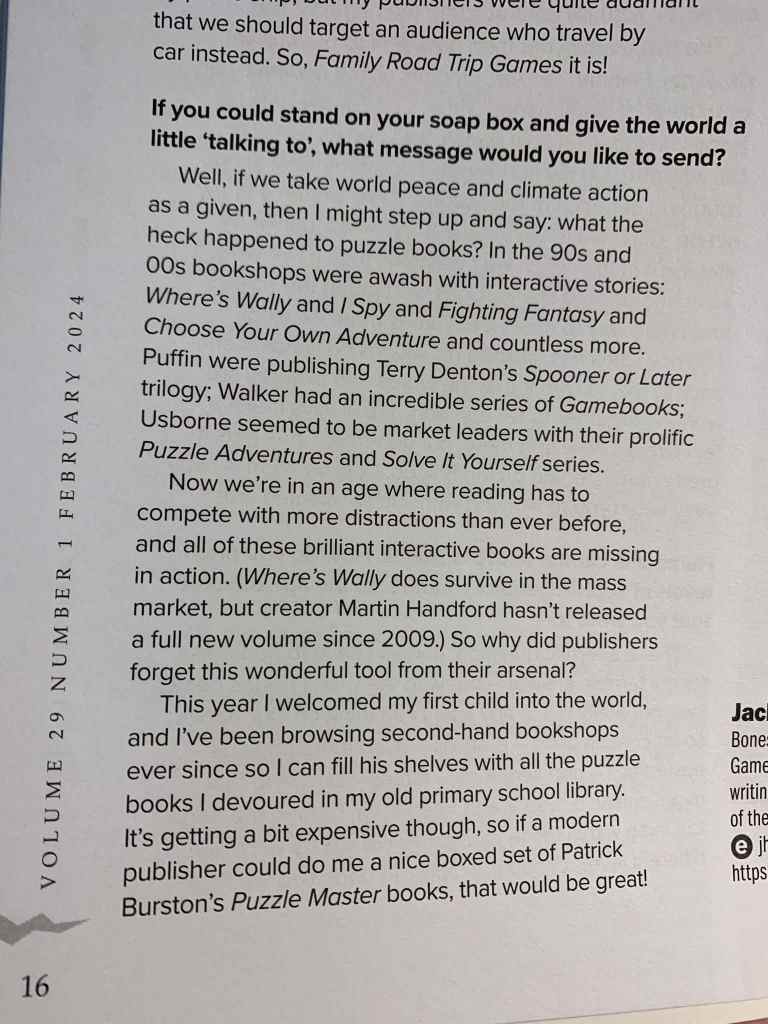
Can you tell I feel strongly about puzzle books? I loved turning each page of the 90s classics listed above, never knowing what fiendish riddle I’d be asked to unpick next. It’s a type of mental challenge that I think has been taken up very successfully by the “escape room” format, which lets players explore a physical space as they interact with various cluey objects — with the trade off being that escape rooms are big, loud, social occasions, rather than something to quietly noodle away at in an armchair. So to repeat myself: what the heck happened to puzzle books?
At the time of the interview I had just written a little puzzle of my own, snuck into the back of Family Road Trip Games: a devious 1+ player game entry simply called Treasure Hunt. The Treasure Hunt entry was a ruse to squeeze a mini escape room-style experience into our book of games, with the reader required to solve clues and codes hidden across the pages to locate a hidden diamond. It wasn’t really a game per se, but I thought it would be a fun solo experience for anyone flipping through the book on their lonesome. How hard could it be?
Well, in hindsight: that treasure hunt was really hard. It was hard for my editors, who had to slot in sneaky bits of text in unexpected places. It was hard for my designer, who had to change the uniformity of his design work to include multiple sets of cryptic symbols. And it was hard for readers, who really couldn’t have anticipated how difficult and demanding some of those clues were going to be. Some of those readers have reached out to me asking for additional clues, which I have happily provided — and I’m extra happy to know that in some cases, the diamond has now been successfully found!
Family Road Trip Games was not a puzzle book, and it was probably a mistake to jam a puzzle inside it. But it did get me thinking about what other puzzles I might like to write. So when my editor on the series reached out and asked whether I might consider writing an entire book of puzzles, the answer was a resounding “absolutely, yes please!”
This Book is a Treasure Hunt is my attempt to recapture the spirit of a 90s puzzle book, where every page is a brain-bending new adventure. Said adventure takes place in a mysterious manor called Lockstep House, with individual puzzles spread across a perplexing parlour, a labyrinthine laboratory, a surprising study, and a curious conservatory. But, there’s also an overarching ultimate puzzle, where the answers you’ve collected will help you locate a priceless treasure: the Midnight Star. Any reader could open this book and solve some of the puzzles, but completing the book and claiming the lost jewel will truly require a feat of puzzling perfection.
The book contains some puzzle styles that are familiar, and some that are completely unique: my personal favourite is the weather puzzle that uses a barometer, which I am incredibly proud of. That puzzle might actually also count as being my first ever published “illustration,” because I cobbled the barometer together myself in Photoshop using royalty-free photographs to get it exactly right. This screenshot is a bit low-res, but look how pretty it is!
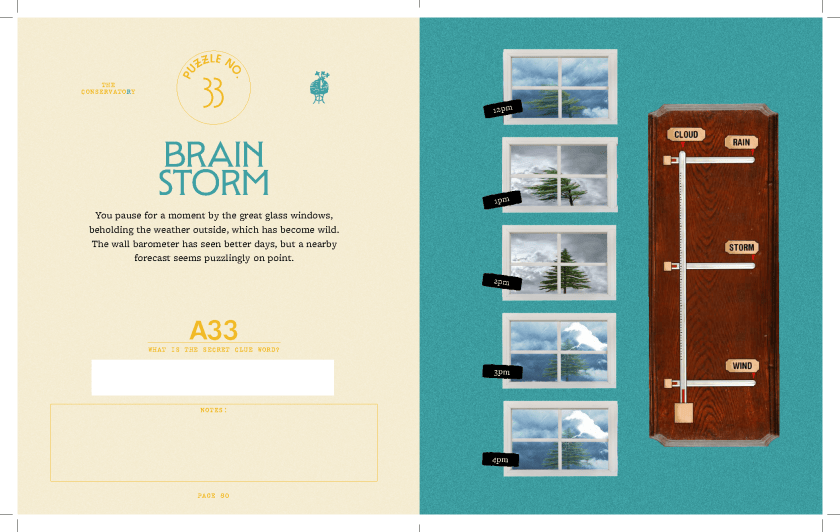
Beyond the barometer, I also had to make a design mock-up of every single one of the 47 puzzles, which really tested my Photoshop skills, and which made this project an utterly unique experience compared to the thirteen books I wrote before it. So for a long time, that lovely colourful barometer puzzle actually looked like this:
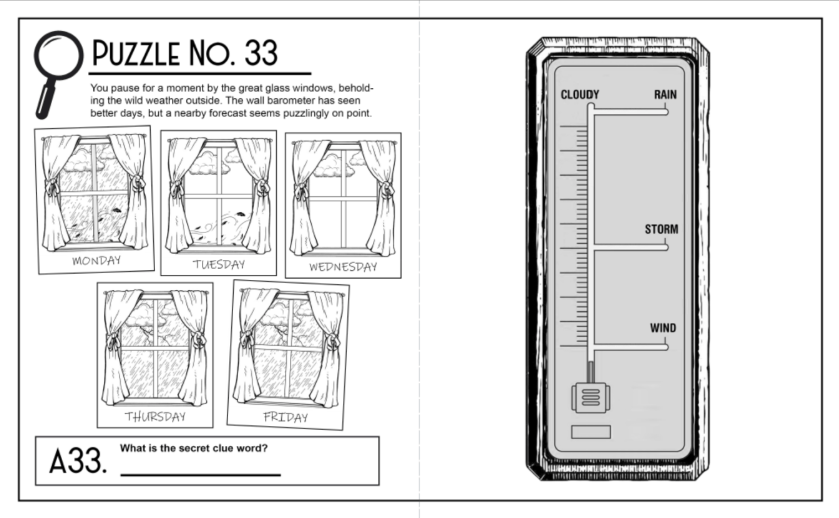
And look, I think that’s a perfectly parsable and passable puzzle, but it does also go to show how valuable a good designer is. (Thanks George!) The finished book is actually so lovely that it’s hard to bring yourself to mark it with a pen, even though you’ll need to do exactly that to solve all the puzzles. Those puzzle locks aren’t going to untangle themselves!
If I could change one thing about this book, it’s that I wish we’d put a suggested age range on the cover. A lot of my books have been for ages 6-8, or 8-12, but this book isn’t necessarily for my youngest readers — although I did recently attend a wedding where a young Cross Bones fan handily solved the first couple of puzzles. (Good one, Clement!) But, for the most part, I think this book is for ages 12 to adult. Give it as a stocking stuffer to anyone in your life who’s a bit puzzle curious, and with any luck they’ll be unravelling riddles and cracking cyphers all the way through to the New Year.
Anyway, thanks for reading. I’ll be back in 2027 with more Family Games and a spooky new collaboration with the great Chris Kennett. Until then, Merry Christmas to all, and happy puzzling!